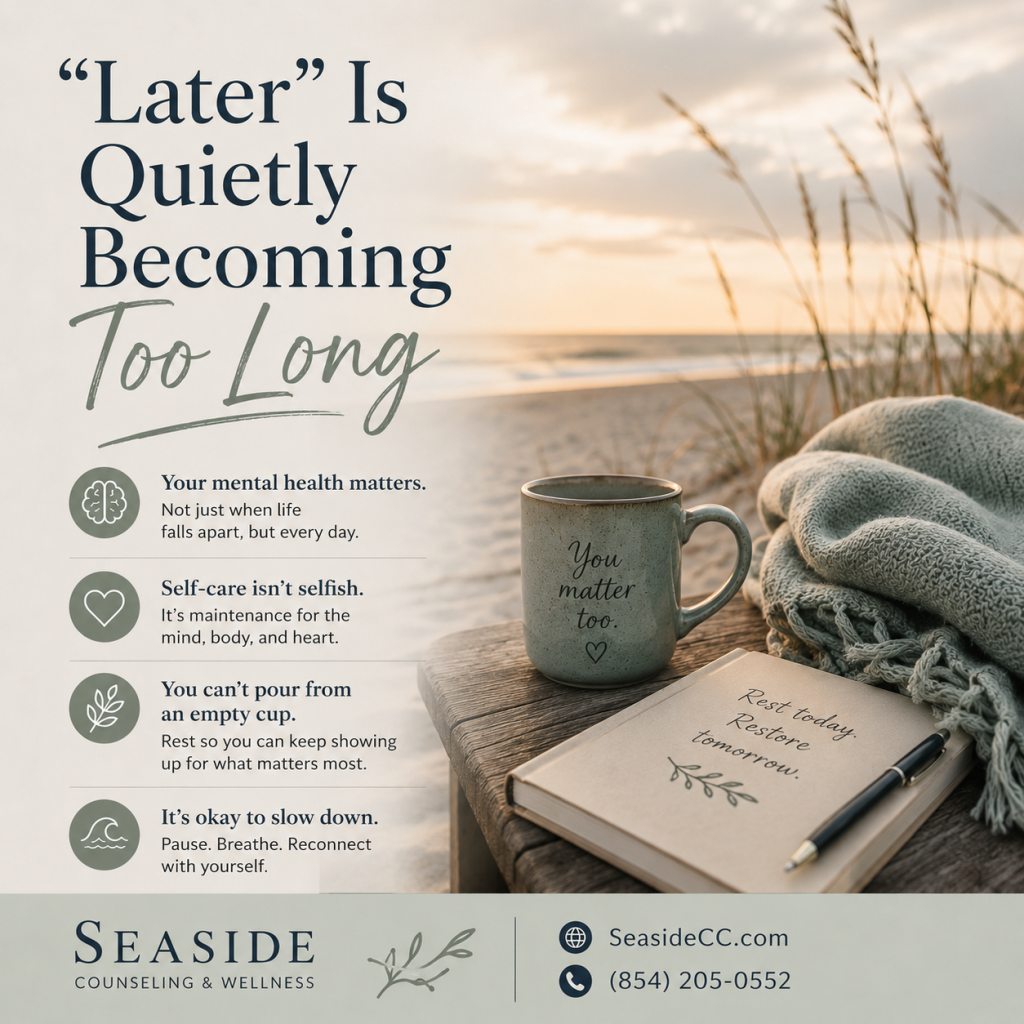
“Later” Is Quietly Becoming “Too Long”
There’s a version of burnout that hides well.
It doesn’t always look dramatic. It doesn’t always stop your life. In fact, many people experiencing it continue functioning every single day. They go to work. Answer texts. Take care of children. Show up for meetings. Keep commitments. From the outside, everything appears manageable.
But internally, something feels increasingly disconnected.
You start telling yourself you’ll rest after this week.
After the project.
After the school year.
After things “slow down.”
And somehow, they never do.
Self-care has become one of the most misunderstood concepts in modern life because most people reduce it to temporary relief. A day off. A massage. A weekend away. A quiet night. Those things matter, but they are not the deeper issue.
Real self-care is often less comfortable than people expect.
Sometimes it means acknowledging that you are emotionally exhausted before your body forces you to stop.
Sometimes it means admitting that you have spent months prioritizing productivity over yourself.
Sometimes it means recognizing that being “needed” by everyone else has slowly disconnected you from your own needs entirely.
A lot of people postpone caring for themselves because they believe their exhaustion is not serious enough yet. They convince themselves other people have it worse. That they should be grateful. That they’re just stressed. That pushing through is normal.
And to a degree, stress is normal.
Living disconnected from yourself is not.
When people continuously delay caring for their mental and emotional health, the effects rarely arrive all at once. They accumulate quietly. Patience becomes shorter. Joy becomes harder to access. Rest no longer feels restorative. Conversations feel draining. Motivation fades. Even moments that are supposed to feel meaningful start feeling muted.
What makes this difficult is that many high-functioning people become extremely skilled at masking it. They keep performing while internally running on empty.
Over time, survival mode starts feeling like personality.
You begin accepting exhaustion as your baseline.
The problem is that the body and mind eventually collect the debt. What gets postponed emotionally often resurfaces physically, relationally, or mentally later. Chronic stress, anxiety, irritability, emotional numbness, difficulty sleeping, loss of connection, and burnout rarely appear overnight. They are usually the result of needs being ignored for too long.
Self-care is not selfishness.
It is maintenance.
The same way relationships require attention, mental health does too. The same way you would not expect a vehicle to run indefinitely without care, people cannot continue operating at high emotional output without restoration.
And restoration is not always dramatic.
Sometimes it begins with slowing down long enough to notice that you are not okay.
Sometimes it begins with honesty.
Sometimes it begins with finally talking to someone instead of carrying everything internally.
At Seaside Counseling & Wellness, we work with many individuals who are not falling apart outwardly — they are simply tired of carrying everything alone. Therapy is not only for crisis. Often, it is the space where people reconnect with themselves before things reach that point.
You do not have to wait until life becomes unmanageable to care for yourself.
And you do not need permission to begin.


