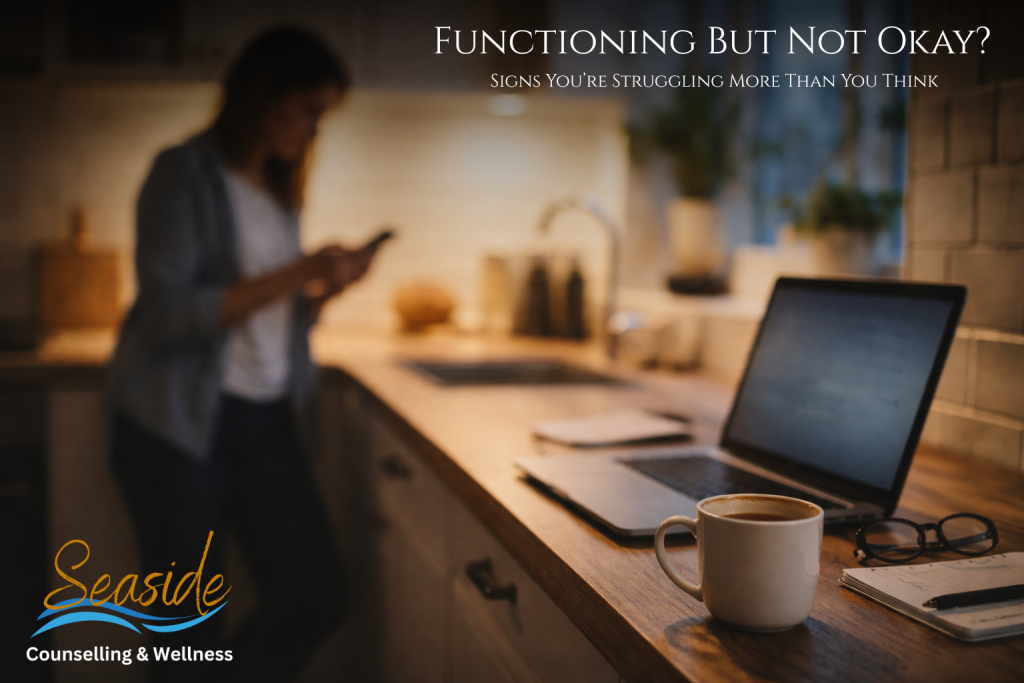
Functioning But Not Okay?
Signs You’re Struggling More Than You Think
Here’s a smoother, more natural-flow version—less segmented, more immersive, and easier to read without feeling like a list:
There’s a version of struggling that doesn’t interrupt your life.
You still wake up on time, go to work, respond to messages, and keep your commitments. From the outside, everything looks steady—maybe even successful. You’re doing what you’re supposed to do, handling what needs to be handled, moving forward the way you always have.
But internally, it feels different.
You’re tired in a way that rest doesn’t fix. Your patience isn’t what it used to be. Conversations take more effort, and moments that should feel meaningful don’t quite land the same way. Things that once came naturally now feel like something you have to push through. Nothing is falling apart—but nothing feels easy either.
This is what it often looks like to be functioning, but not okay.
And because you’re still managing your life, it’s easy to miss. It doesn’t feel serious enough to stop and pay attention to. You tell yourself it’s just stress, or that you’ve been busy, or that this is just part of being an adult. You look at others who seem to be struggling more visibly and assume what you’re feeling doesn’t really count. So you keep going, expecting it to pass.
But that quiet disconnect has a way of building.
Over time, the effort it takes to move through your days increases. What used to feel manageable starts to feel heavier. You notice you’re not as present, not as engaged, not as connected to your own life as you once were. Because it happens gradually, it can begin to feel normal—like this is just how things are now.
That’s often where people get stuck. Not because they don’t recognize that something feels off, but because nothing has forced them to address it.
Being “functional” can hide a lot. It can mask stress that hasn’t been processed, or emotional fatigue from constantly managing responsibilities without pause. It can cover anxiety that isn’t overwhelming but is always there in the background, and the quiet impact of moving through life on autopilot for too long. None of that is obvious from the outside—but internally, it adds up.
At Seaside Counseling & Wellness, this is something we see often. People who are capable, responsible, and reliable, doing everything they’re supposed to do—but not feeling like themselves anymore. Underneath the surface, they feel worn down, disconnected, or quietly overwhelmed, and they’re not always sure when it started.
That uncertainty makes it easy to ignore—but it doesn’t make it unimportant.
You don’t need a breaking point for your experience to matter. You don’t have to wait until things get worse before you take it seriously. In fact, noticing it at this stage—when it’s still subtle—is often what makes it easier to understand and work through.
It can start simply by acknowledging that something feels different. Not rushing to fix it, and not trying to label it too quickly, but allowing yourself to notice it without pushing it aside.
From there, it becomes easier to ask the kinds of questions that don’t always get space. When did this start to feel harder? What feels the most draining right now? Where do you feel the most disconnected—from your work, your relationships, or even from yourself?
You don’t need perfect answers. But creating space to notice those patterns is often where things begin to shift.
Because functioning shouldn’t come at the cost of how you feel internally. And feeling “not okay” doesn’t require everything to fall apart first. Sometimes it’s enough to recognize that something feels off—and to take that seriously before it turns into something bigger.


